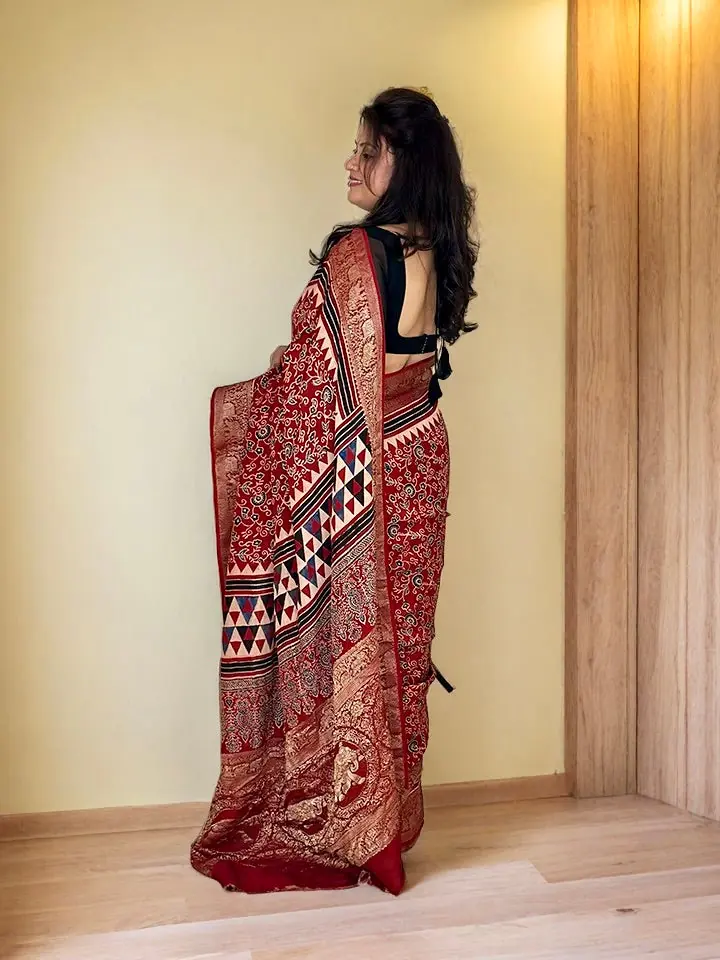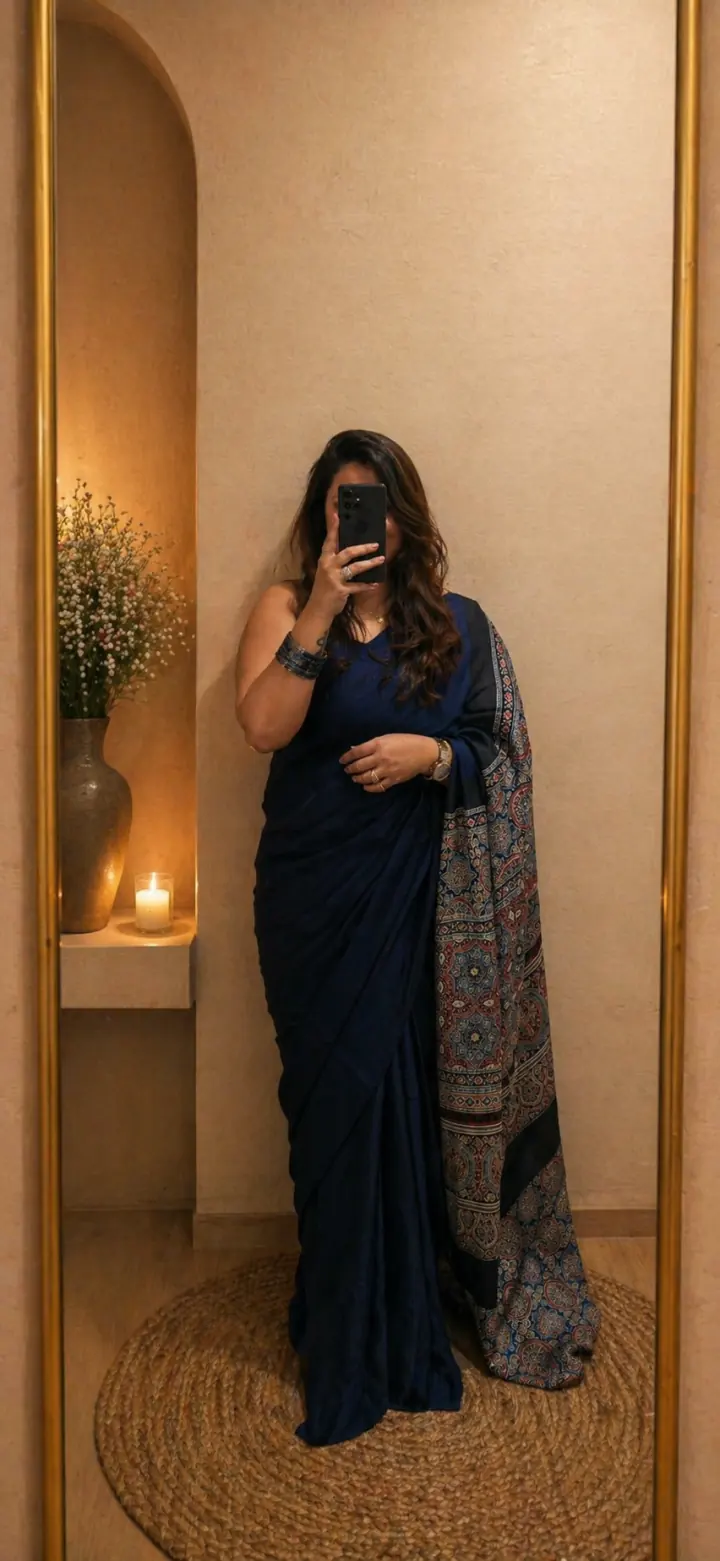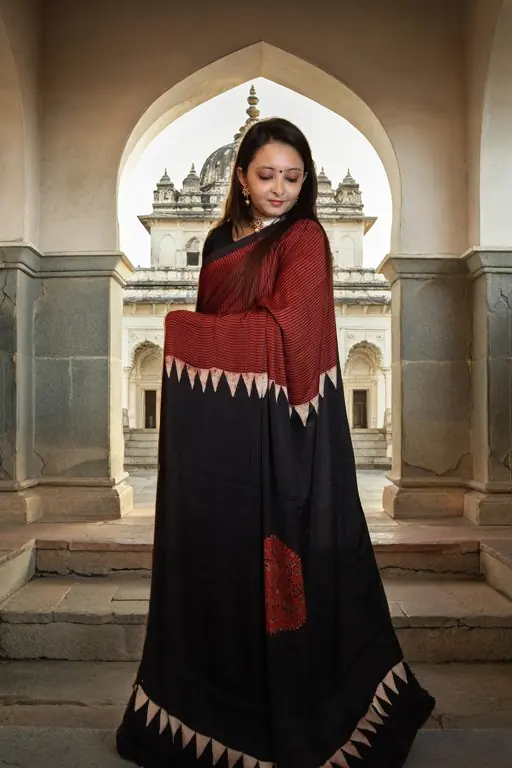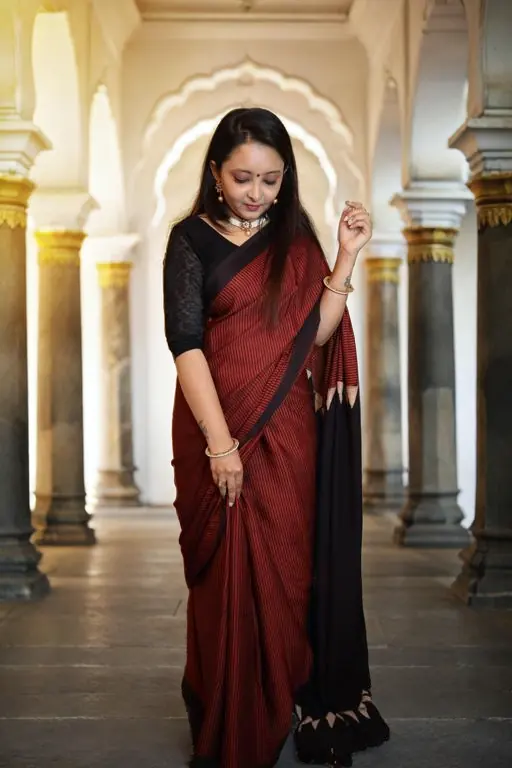
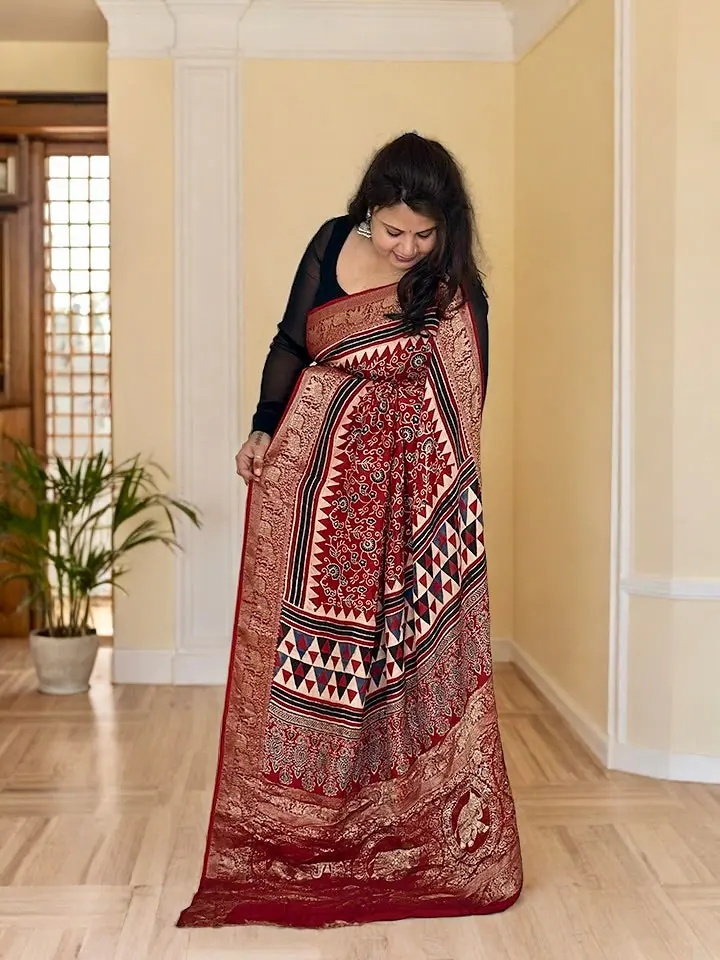
Ajrakh is a hand block-printed, resist-dyed textile from Kutch in Gujarat and neighbouring Sindh, recognised by deep indigo, madder red and black geometry on a pale ground. The pattern is not simply printed on top: it is built up through repeated cycles of resist, mordant and dye, which is why a real piece looks nearly the same on both sides.
What does "Ajrakh" actually mean?
The word is usually linked to the Arabic term for blue, and indigo is certainly the backbone of the palette. Scholars say the etymology is likely rather than proven, so treat it as the favoured explanation, not a settled fact. What is settled is the look: tightly packed grids, stars, vines and interlocking medallions in blue, red, black and cream, arranged so that the eye reads one continuous lattice.
Ajrakh is traditionally worn and used, not just admired. Maldhari herding communities in Kutch have long worn it as turbans, shoulder cloths and lungis, so the cloth has a long working life. When you drape an Ajrakh saree you are wearing a textile that began life as everyday dress.
Where does Ajrakh come from?
The craft is closely tied to the Khatri community of printers and dyers. Most accounts say the tradition was carried from Sindh into Kutch when Khatri families moved there roughly five centuries ago, and a well-known version of the story links the move to a sixteenth-century Kutch ruler who invited skilled artisans to settle in his territory. Dates and details differ from source to source, which is normal for a craft that was passed down by apprenticeship rather than in written records.
Older threads of the story reach much further back. Indigo dyeing and Gujarati printed cloth were already established trade goods by the fourteenth century, and fragments of western Indian printed textiles have turned up in Egyptian excavations. Some popular retellings go on to claim an Indus Valley origin. That is a romantic link rather than a documented one, so it is safer to say Ajrakh belongs to a very old regional tradition of indigo and madder printing.
Today Kutch Ajrakh carries a Geographical Indication registration, which recognises its place of origin and method, and several printing families have worked to keep the full natural-dye process alive.
How is Ajrakh made?
Craftspeople and writers count the stages differently. Government craft profiles describe fourteen stages, other writers list sixteen or more, and some artisans count well over twenty once washing and drying are included. Rather than memorise a number, it helps to understand the logic, which repeats three ideas: prepare the cloth, protect the areas that should stay light, then fix colour.
1. Preparing the cloth
Raw cotton, or today sometimes silk or a silk blend, is washed and scoured to remove starch and impurities. Traditionally this is done by soaking the cloth repeatedly, beating it, and treating it so that it will accept dye evenly. Skipping this stage is one reason cheap imitations bleed or look flat.
2. Mordanting
A mordant is a substance that helps natural dye grip the fibre. Ajrakh printers have long used myrobalan (harda), alum and lime-based mixtures, and the first treatment gives the cloth its warm, slightly golden undertone. Without mordant, madder would wash out rather than turn into a lasting red.
3. Block printing the resist
This is the part that gives Ajrakh its precision. Carved wooden blocks are dipped into a resist paste, traditionally made from ingredients such as lime, gum and clay, and pressed onto the cloth. Wherever resist sits, dye cannot reach. Each design generally needs more than one block: an outline block that lays down the structure and further blocks that fill in the details, and each has to land in exact register with the last.
Many traditional printers print both sides of the cloth so the pattern lines up front and back. That is the reason a well-made piece reads clearly from either face.
4. Dyeing and repeating
The cloth is dipped into dye vats and then washed. Madder-based baths produce reds, indigo vats produce blues, and iron-based mixtures produce black. Because resist is applied in layers, the cloth goes back for another round of printing and dyeing for the next colour. A full piece takes anywhere from about two to three weeks, with waiting periods between stages so that colours deepen.
5. Washing and finishing
Ajrakh is rinsed thoroughly in running water to clear leftover resist and excess dye. This final wash is what reveals the sharp white lines and the settled colours.
What are the colours and motifs?
Natural palettes are limited, but they are rich. Indigo gives blues from sky to near black, madder produces warm reds, and iron combined with tannin sources gives black. The unprinted cloth supplies the cream.
Motifs lean geometric because they are easiest to carve and register: eight-pointed stars, jaalis (lattice grids), small flowers, vines and borders of repeated bars. Meanings attached to individual motifs vary by family and region, so be a little sceptical of any listing that promises one fixed symbolic reading.
How can you tell real Ajrakh from a screen print?
No single test is perfect, but these checks work together.
- Look at the reverse. Hand-block resist printing lets colour pass into the cloth, so the back should look close to the front. A screen print or digital print usually leaves a visibly paler wrong side.
- Check the register. Blocks are placed by hand, so tiny shifts, soft overlaps and variations between repeats are normal. A perfectly mechanical repeat down the length of the cloth is a sign of machine printing.
- Look for the edges of the resist. Blocked lines have a slightly organic edge. Photographic sharpness or gradients that look like pixels point to digital printing.
- Judge the colour. Natural indigo and madder look deep and slightly complex, not neon. Very bright, flat, uniform reds and blues are often chemical dyes.
- Ask what the seller can tell you. A maker or curator who knows a piece should be able to say where it was printed and what kind of block and dye were used.
One honest caveat: hand-block printing and natural dyeing are two different claims. A piece can be hand-block printed with chemical dyes and still be a genuine, lovely Ajrakh-style textile. Ask which of the two you are being told, and be wary of any listing that blurs them.
Ajrakh on silk, modal and mul cotton
Cotton is the traditional ground, and Ajrakh on cotton is still the benchmark. Printers have, however, adapted the technique to other fibres, and silk, silk blends and modal take the pattern in their own way. Silk and silk-like cloths give a luminous sheen that cotton cannot, and they make the pallu (the decorated end of the saree) look almost jewelled. If you are choosing between fabrics, our guide to modal silk versus pure silk explains how each behaves, and the dola silk guide covers the glossier option.
Styling an Ajrakh saree
Ajrakh is bold on its own, so keep the rest quiet.
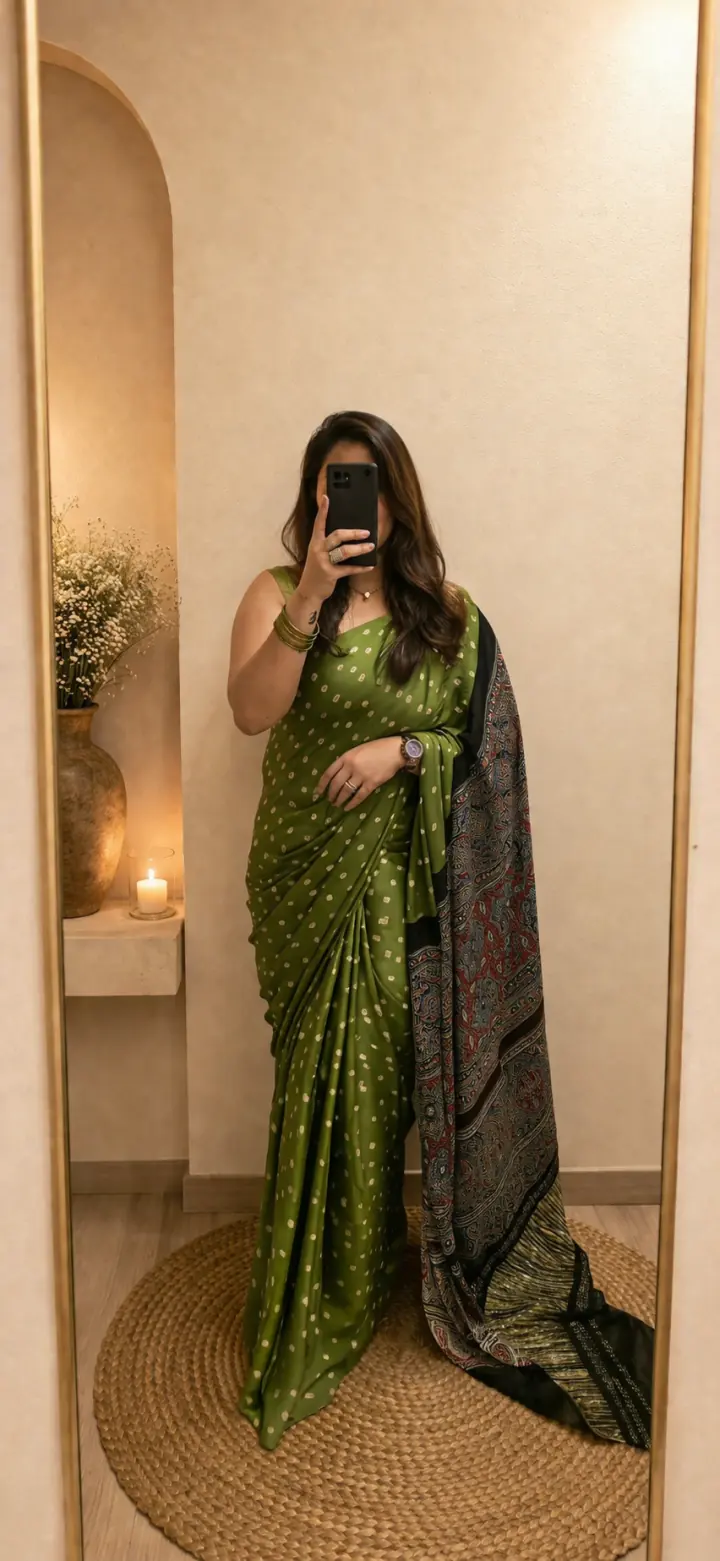
- Pair a printed pallu with a plain body in a matching or contrasting solid. Pieces such as the plain modal silk saree with Ajrakh pallu in ink blue let the printed end do the talking.
- Choose a plain blouse in a deep shade picked from the print: indigo, maroon or black.
- Keep jewellery simple. Oxidised silver or a single gold piece works better than layered sets.
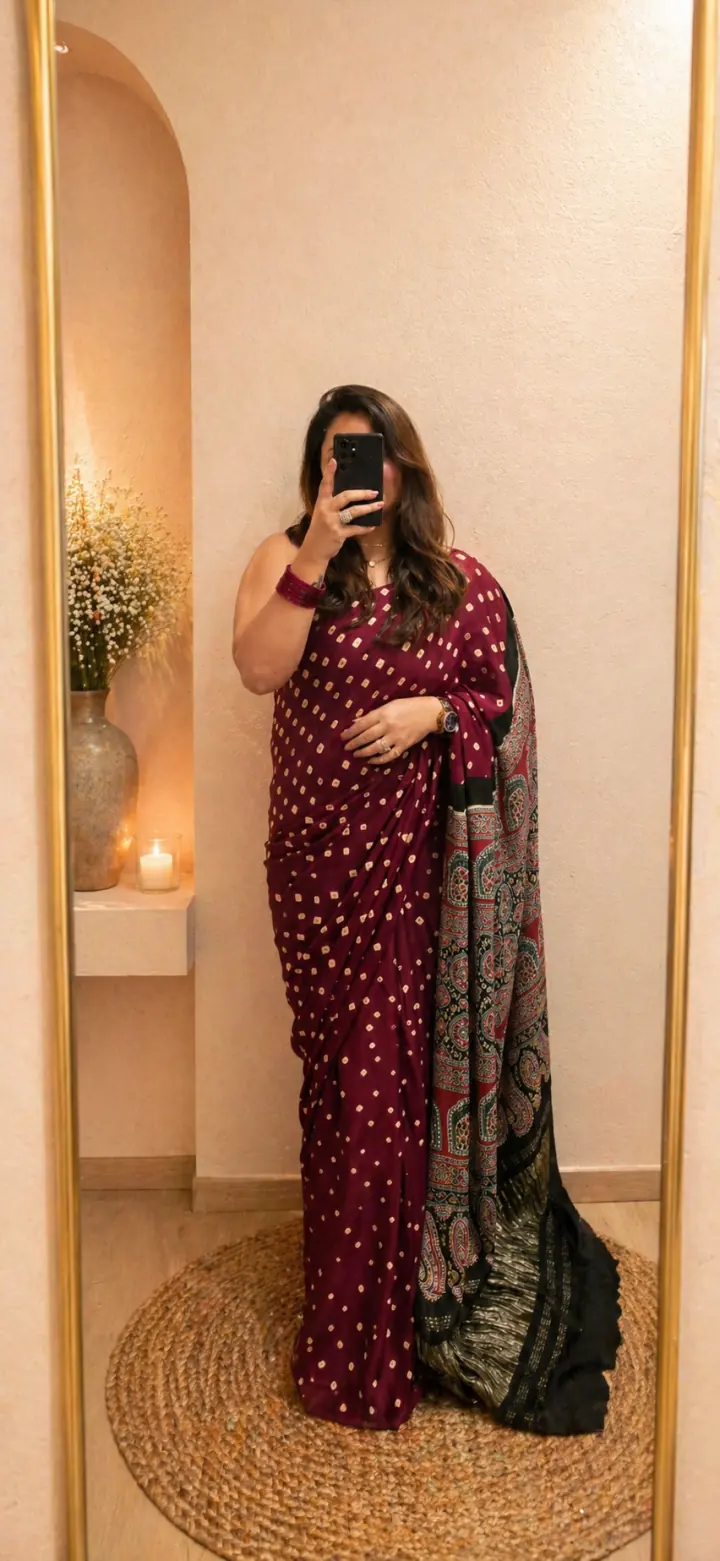
- For festive evenings, a dola silk Ajrakh saree in maroon gives structure and sheen.
If you like the idea of mixing crafts, the Bandhani modal silk with an Ajrakh pallu pairs tie-dye dots on the body with block printing on the end. Our Bandhani guide explains how the dots are made, and the Bandhani sarees page collects the current pieces.
Where to find Ajrakh at Eeshani
Eeshani is a Bengaluru label whose founders hand-pick limited pieces from printers and weavers in Kutch and Varanasi. You can browse the full edit in Ajrakh sarees, shop the Dola Silk Ajrakh collection, or look at festive sarees for pieces with a printed pallu. Prices across the range run from ₹1,799 to ₹6,299, we ship worldwide, and returns are accepted within three days.
Caring for Ajrakh
Treat it as a textile you intend to keep. Check the care label first, since silk and modal pieces are often dry clean only. Keep any Ajrakh piece away from direct sunlight, store it folded in cotton or muslin, and avoid soaking it for long periods, because even stable dyes can bleed slightly in the first few washes. Our silk saree care guide covers storage and ironing in detail.